Perfect Hand-Rolled Pappardelle with Slow-Braised Cinghiale Ragù
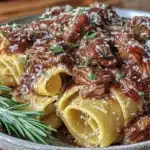
A rustic Italian recipe featuring hand-rolled pappardelle pasta paired with a slow-braised wild boar ragù, delivering authentic Tuscan flavors and a hearty, comforting meal.
- Prep Time: 45 minutes
- Cook Time: 3 hours 30 minutes
- Total Time: 4 hours 15 minutes
- Yield: 4 servings
- Category: Main Course
- Cuisine: Italian
Ingredients
- All-purpose flour – 2 cups (250g), plus extra for dusting
- Large eggs – 3, room temperature
- Extra virgin olive oil – 1 tablespoon (for dough)
- Salt – a pinch (for dough)
- Wild boar shoulder or stew meat – 2 pounds (900g), cut into chunks
- Extra virgin olive oil – 3 tablespoons (for ragù)
- Yellow onion – 1 large, finely chopped
- Carrots – 2 medium, diced
- Celery stalks – 2, diced
- Garlic cloves – 4, minced
- Tomato paste – 2 tablespoons
- Crushed tomatoes – 14 ounces (400g) can
- Dry red wine – 1 cup (240ml), preferably Chianti or Sangiovese
- Fresh rosemary – 2 sprigs
- Fresh thyme – 2 sprigs
- Bay leaves – 2
- Salt and freshly ground black pepper – to taste
- Water or beef broth – as needed for braising
- Grated Pecorino Romano cheese – for serving
- Fresh flat-leaf parsley – chopped, for garnish (optional)
Instructions
- Make the pasta dough: In a large bowl, mound the flour and create a well in the center. Crack in the eggs, add olive oil and salt. Using a fork, gently whisk the eggs, gradually pulling in flour from the edges until a shaggy dough forms (about 5 minutes). If dough is too sticky, sprinkle more flour; if too dry, add a teaspoon of water.
- Knead the dough: Transfer dough to a floured surface and knead for 8-10 minutes until smooth and elastic. Dough should spring back slightly when pressed.
- Rest the dough: Wrap dough in plastic wrap and let rest at room temperature for 30 minutes.
- Roll and cut the pappardelle: Divide dough into 2 or 3 portions. Roll each piece into a thin rectangle about 1/16 inch (1.5 mm) thick. Slice into wide strips about 3/4 inch (2 cm) wide using a sharp knife or pizza cutter. Keep unused dough covered.
- Prepare ragù base: Heat 3 tablespoons olive oil in a Dutch oven over medium heat. Add chopped onions, carrots, and celery. Cook gently for 8-10 minutes until soft and translucent.
- Brown the wild boar: Increase heat to medium-high. Add wild boar chunks and sear until browned on all sides, about 5-7 minutes. Brown in batches if needed to avoid overcrowding.
- Add garlic and tomato paste: Stir in minced garlic and tomato paste. Cook for 2 minutes until fragrant and paste darkens slightly.
- Deglaze with red wine: Pour in wine, scraping browned bits from bottom. Simmer and reduce by half (5-7 minutes).
- Add tomatoes and herbs: Stir in crushed tomatoes, rosemary, thyme, and bay leaves. Season with salt and pepper. Add enough water or beef broth to just cover meat.
- Braise the ragù: Bring to gentle simmer. Cover partially and cook on low heat for 3-4 hours, stirring occasionally. Meat should be tender enough to pull apart with a fork. Add water if sauce thickens too much.
- Cook the pappardelle: Bring large pot of salted water to boil. Add fresh pappardelle and cook 2-3 minutes until al dente. Drain and reserve some pasta water.
- Combine and serve: Toss pasta with ragù, adding reserved pasta water if needed to loosen sauce. Plate generously, sprinkle with grated Pecorino Romano, and garnish with parsley if desired.
Notes
[‘If dough is too sticky, chill briefly before rolling.’, ‘Roll dough evenly for consistent cooking.’, ‘Avoid overcrowding meat when browning to ensure caramelization.’, ‘Low and slow braising is essential for tender meat.’, ‘Use fresh herbs whole to easily remove before serving.’, ‘Reserve pasta water to help sauce cling to pasta.’, ‘Wild boar can be substituted with pork shoulder or beef chuck.’, ‘For gluten-free pasta, use gluten-free flour blends but hand-rolling may be difficult.’, ‘Add a pinch of red chili flakes for subtle heat if desired.’, ‘Add diced butternut squash or roasted bell peppers during last hour of braising for variation.’, ‘Leftover ragù can be refrigerated up to 3 days or frozen up to 3 months.’]
Nutrition
- Serving Size: 1 serving (approxima
- Calories: 650
- Sugar: 8
- Sodium: 550
- Fat: 28
- Saturated Fat: 6
- Carbohydrates: 65
- Fiber: 5
- Protein: 38
Keywords: hand-rolled pappardelle, cinghiale ragù, wild boar ragù, slow-braised ragù, Tuscan pasta, homemade pasta, Italian recipe, rustic Italian, fresh pasta, slow cooking